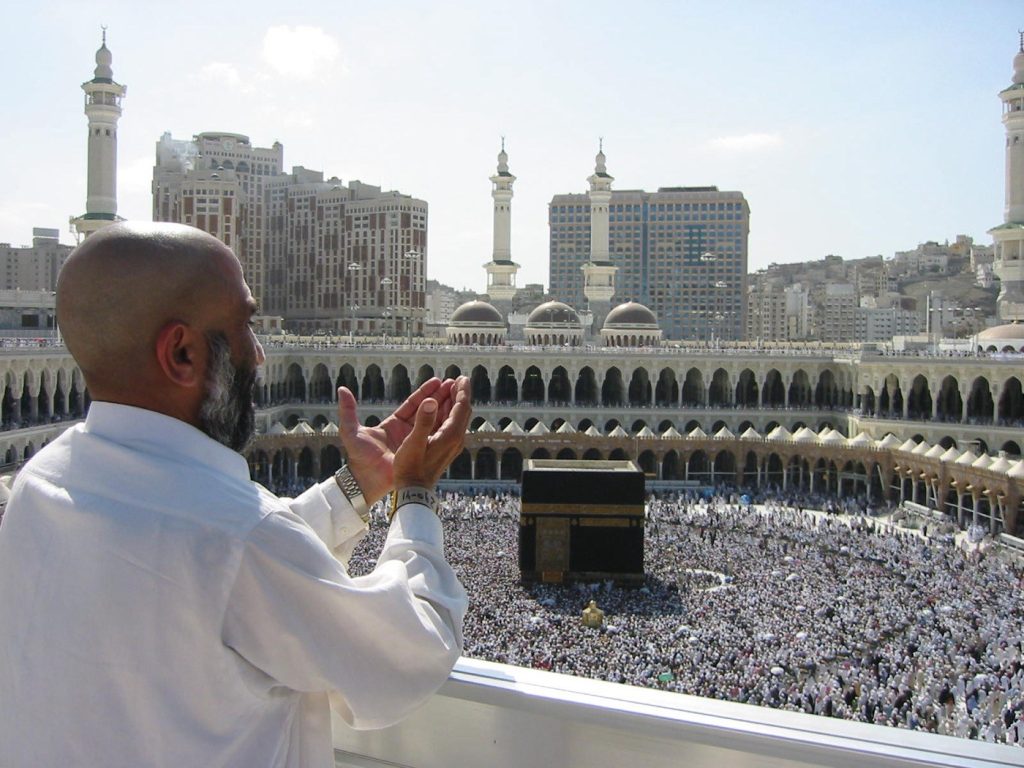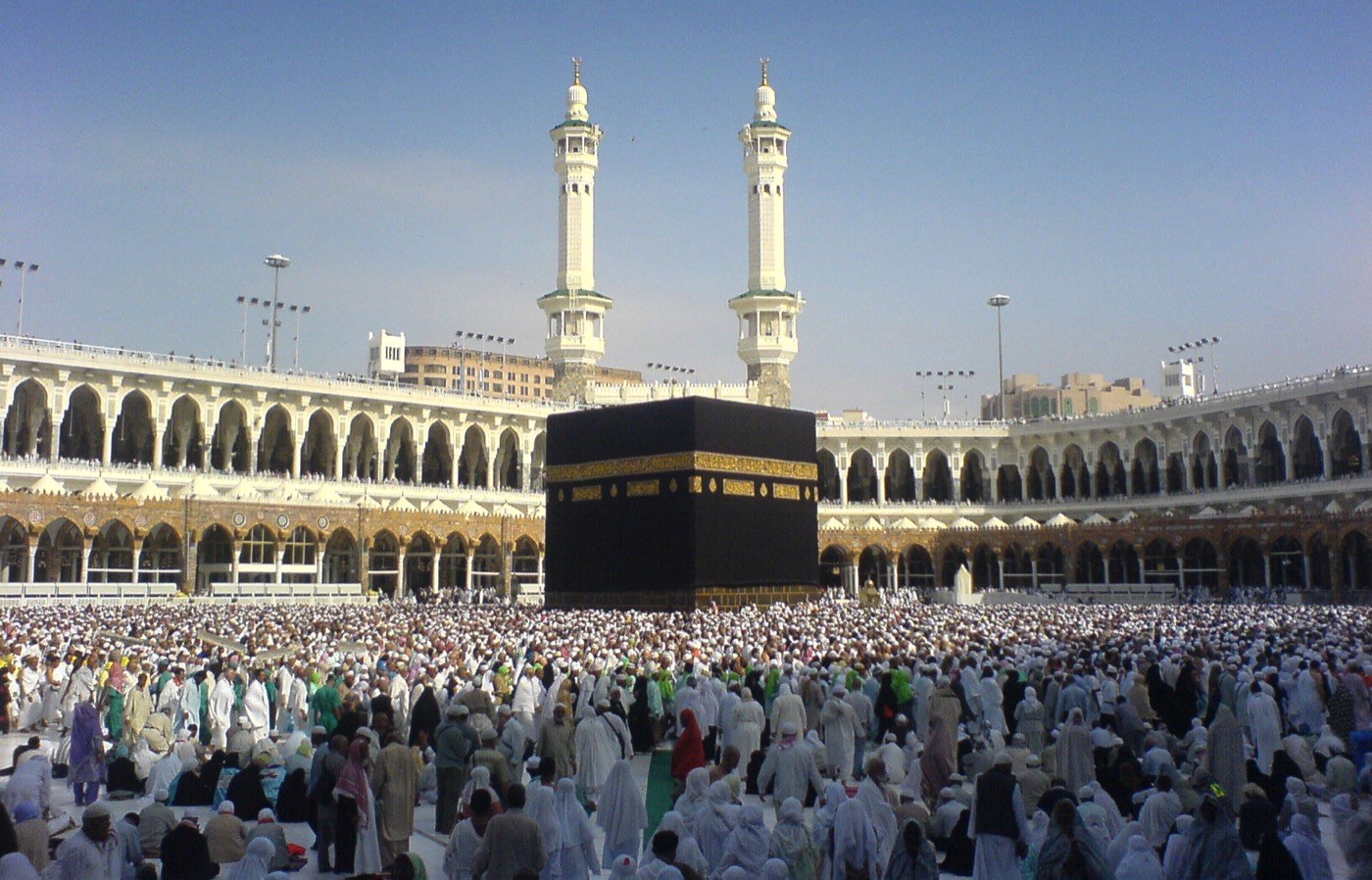
In its literal sense, Hajj means to visit places worthy of reverence. In Islam it is defined as standing for a period at Arafat at its appointed time and visiting the Kaaba by performing the Tawaf according to its rules. A person who performs Hajj is called a hajji.
One of the five pillars of Islam, Hajj is obligatory for everyone who has the means.
Almighty God has said:
وَلِلّٰهِ عَلَى النَّاسِ حِجُّ الْبَيْتِ مَنِ اسْتَطَاعَ اِلَيْهِ سَبٖيلًا
“Pilgrimage to the House is a duty owed to God by all who are able to make the journey.” [Al Imran 97]
The Messenger of God (peace and blessings be upon him) said:
بُنِىَ الإِسْلاَمُ عَلَى خَمْسٍ شَهَادَةِ أَنْ لاَ إِلَهَ إِلاَّ اللَّهُ وَأَنَّ مُحَمَّدًا رَسُولُ اللَّهِ، وَإِقَامِ الصَّلاَةِ ، وَإِيتَاءِ الزَّكَاةِ ، وَصَوْمِ رَمَضَانَ ، وَالْحَجِّ
“Islam is built upon five foundations: bearing witness that there is no god but God and that Muhammad (peace and blessings be upon him) is His Messenger, establishing the prayer, giving zakat, fasting in Ramadan, and performing the Hajj.” [Bukhari, Muslim]
Because Hajj is an act of worship performed with both wealth and body, the Prophet (peace and blessings be upon him) advised us not to delay it. Ibn Abbas (may God be pleased with him) related:
The Messenger of God (peace and blessings be upon him) said:
“Whoever intends to perform Hajj, let him hasten to it. For a person may fall ill, lose his mount, or be prevented by some other matter.” [Ahmad, Ibn Majah]
The time of Hajj
There are conditions for the acceptance of Hajj, and performing it at its proper time is among the most important of them. A Muslim therefore cannot perform Hajj at any time of year they choose. Visits made to the holy lands outside the days of Hajj can only be counted as Umrah.
To perform Hajj, Muslims must be at Arafat in a state of Ihram on the eve of Eid al-Adha and make the standing there. Hajj is not limited to the standing at Arafat, however: to complete this pillar of Islam, the other obligatory and required acts of Hajj must also be carried out after the standing.
The obligatory acts (fard) of Hajj
Hajj is completed by fulfilling its obligatory and required acts. The obligatory acts may differ slightly between the schools of law. Further detail can be found on our page about the obligatory acts of Hajj.
The required acts (wajib) and the types of Hajj
The word wajib means something that is strongly required. An act of worship whose required parts are missing will itself be deficient. Although in exceptional cases no penalty is due for a required act omitted through a valid excuse, a penalty (expiation) may be required for many required acts that are omitted, whether excused or not. For a Hajj that is accepted, therefore, its required acts must also be completed in full.
Hajj also comes in different types. According to how it is performed, Hajj is divided into Qiran, Ifrad and Tamattu. Further detail can be found on our page about the required acts and types of Hajj.
Tawaf in the Hajj
Tawaf, meaning to turn or to go around, is to circle the Kaaba seven times starting from the line of the Black Stone, keeping the Kaaba on your left. Each circuit around the Kaaba is called a shawt.
In terms of their rulings there are seven kinds of Tawaf: the Tawaf al-Qudum, the Tawaf al-Ifadah, the farewell Tawaf, the Umrah Tawaf, the vowed Tawaf, the voluntary Tawaf and the Tawaf of greeting the mosque.
Certain conditions must be met for the Tawaf to be valid. They are as follows:
1 — Intention
Islam attaches great importance to intention, not only in acts of worship but in everything one does. For the Tawaf to be accepted by Almighty God, an intention must be made. A Tawaf performed without intention is not accepted. (Only in the Shafi’i school is intention not a condition for the Tawaf al-Ifadah and the Tawaf al-Qudum, because in intending the rites of Hajj the Shafi’is have also intended the Tawaf.)
Just as the Tawaf has its conditions, so does the intention. Anyone wishing to perform Tawaf must make the intention before passing the line of the Black Stone. If the intention is made after passing that line, the circuit does not count, and the following circuit becomes the first.
2 — Performing the Tawaf at its proper time
Tawaf al-Qudum: to be performed after entering Ihram for Hajj and before the standing at Arafat.
Umrah Tawaf: to be performed after entering Ihram.
Tawaf al-Ifadah: performed after the standing at Arafat, after true dawn on the first day of Eid al-Adha.
Farewell Tawaf: performed after the Hajj has been completed.
3 — Performing the Tawaf around the Kaaba
For the Tawaf to be accepted it must be performed within the boundaries of the Haram and around the Kaaba.
4 — Completing at least four circuits
The first four circuits of the Tawaf are obligatory. Completing the Tawaf to seven circuits is required. The Tawaf of a person who completes four circuits is valid, but it should be completed to seven so that no penalty is incurred.
The Tawaf prayer
In the Hanafi school, unless it is a disliked (makruh) time, it is required to perform two rak’ahs of the Tawaf prayer after the Umrah Tawaf or a voluntary Tawaf. In the Shafi’i school there are no disliked times, so performing the Tawaf prayer at any time is a sunnah. Those with missed prayers to make up, however, make them up instead of the Tawaf prayer.
The Tawaf prayer is performed as follows:
First say, “O God, I intend to perform the Tawaf prayer for Your sake,” and make the opening takbir.
Then continue in this order:
In the first rak’ah:
Hanafis recite the Subhanaka, Shafi’is the Wajjahtu. (Those who do not know the Wajjahtu may recite the Subhanaka.) Then, in order: the ta’awwudh and basmalah, Surah al-Fatihah and Surah al-Kafirun.
In the second rak’ah:
First the ta’awwudh and basmalah, then in order: Surah al-Fatihah, Surah al-Ikhlas, the tashahhud and the salam.
The merit of Tawaf
Ibn Abbas (may God be pleased with him) related: “The Messenger of God (peace and blessings be upon him) said:
“Tawaf around the House is like prayer, except that you may speak during it. So whoever speaks during Tawaf, let him speak only good.” [Tirmidhi; Nasa’i]
In another narration from Nasa’i:
“Speak little during Tawaf, for you are in prayer.” [Nasa’i]
Amr ibn Shu’ayb (may God be pleased with him) related: I heard the Messenger of God (peace and blessings be upon him) say:
“With every step a person takes in Tawaf, setting down one foot and lifting the other, God erases one of his sins and records one good deed for him.” [Tirmidhi]
It is related in the book Bahjat an-Nufus:
“The Kaaba is shared between people and angels. Each year a fixed number of people and angels perform Tawaf around it. If the number of people performing Tawaf falls short, God (glorified be His majesty) completes that number with His angels.”
Ibn Abbas (may God be pleased with him) related: “The Messenger of God (peace and blessings be upon him) said:
“Whoever performs Tawaf around the House fifty times will be cleansed of his sins and will be as on the day his mother bore him.” [Tirmidhi]
“By fifty circuits it is not meant that they be performed one after another at a single time. What is intended is that fifty Tawafs be recorded in the person’s book of deeds, even if completed over a lifetime.”
The Prophet (peace and blessings be upon him) said:
“When a pilgrim performs his final Tawaf at the Kaaba, he is cleansed of his sins as on the day his mother bore him.” [Ibn Majah]
Zamzam
Zamzam is drunk facing the Kaaba, beginning with the basmalah. It is a sunnah to drink it fully in three draughts and to pour some over the hands, face and head.
The Messenger of God (peace and blessings be upon him) said:
“Zamzam is for whatever purpose it is drunk.” It is recommended to drink it with a supplication:
اٰللَّهُمَّ إِنِّى أَسْأَلُكَ عِلْمًا نَافِعًا وَرِزْقًا واسِعًا وَشِفَائًا مِنْ كُلِّ دَاءٍ وَسَقَمٍ
“Allahumma inni as’aluka ‘ilman nafi’an wa rizqan wasi’an wa shifa’an min kulli da’in wa saqam.”
“O God, I ask You for beneficial knowledge, abundant provision, and healing from every illness and ailment.”
After drinking Zamzam, one walks towards the hill of Safa for the Sa’y.
Sa’y in the Hajj
The Sa’y should be performed after the Tawaf.
On reaching the hill of Safa, turn towards the qiblah. Make the intention by saying, “O God, I wish to perform the Sa’y of Umrah for Your sake. Make it easy for me and accept it from me.” Raise the hands as in supplication and pray with takbir, tahlil and blessings upon the Prophet. Then walk towards Marwah with supplication and remembrance. Men walk briskly, almost at a run, along the stretch marked by the green lights; this is called harwalah. On reaching Marwah, the same supplications and remembrance are made as at Safa. Walking from Safa to Marwah completes one circuit.
After the supplications, walk back from Marwah to Safa. Here too men should walk briskly along the stretch marked by the green lights. On reaching Safa, the same supplications and remembrance made at Marwah are repeated. This return from Marwah to Safa completes the second circuit.
Seven circuits are completed in this way. The Sa’y ends on reaching Marwah on the seventh circuit. Once the Sa’y is complete, the hair is cut and Ihram is left.
A word about the hills of Safa and Marwah, where the Sa’y is performed.
Safa is a small hill 130 m from the Kaaba. It is where the Sa’y begins. Marwah is a small hill 300 m from the Kaaba. It is where the Sa’y ends.
In the age before Islam there was an idol called Isaf on Safa and another called Na’ilah on Marwah. The idolaters would go between them and touch them.
After the coming of Islam and the breaking of the idols, the believers were reluctant to walk between Safa and Marwah, even though it was in origin part of the pure faith of Abraham (peace be upon him), because it had also been practised in the age of ignorance.
Thereupon this verse was revealed:
اِنَّ الصَّفَا وَالْمَرْوَةَ مِنْ شَعَائِرِ اللّٰهِ فَمَنْ حَجَّ الْبَيْتَ اَوِ اعْتَمَرَ فَلَا جُنَاحَ عَلَيْهِ اَنْ يَطَّوَّفَ بِهِمَا وَمَنْ تَطَوَّعَ خَيْرًا فَاِنَّ اللّٰهَ شَاكِرٌ عَلٖيمٌ
“Safa and Marwah are among the symbols of God. So whoever visits the House for Hajj or Umrah commits no sin in going between them. And whoever willingly does good — God is appreciative and all-knowing.” [Al-Baqarah 2:158]