0850 850 49 49 bilgi@saygintur.com 49 Saygın Turizm Seyahat Acentası · Belge No: 5840


RAMADAN UMRAH
20 DAYS
DEPARTING FROM ISTANBUL
Ramadan Special Offer Program · 20 Days
About the Program
About This Program
The 20-day Ramadan Special Offer Program departs from Istanbul for Jeddah on 10.03.2026, transfers to Madinah on 26.03.2026 and returns to Istanbul on 29.03.2026 (19 nights / 20 days). Accommodation is in shuttle-serviced hotels in the Shisha district, 3–4 km from the Haram. The price per person ranges from USD 2,150 to USD 2,900, depending on room type.
The sites to be visited in Makkah and Madinah on Saygın Tur Umrah Programs, in the company of our expert guides, are listed below. With my best wishes that you may benefit from them… For a peaceful Umrah — your gateway to the Holy Lands. With love and respect, Muhammet.
Flight
Return air ticket includedAccommodation
Breakfast and dinner includedVisa
Visa and consular formalities includedGuiding
Saygın Turizm guiding serviceDay-by-Day Itinerary
Daily Itinerary
DAY1
MAKKAH
Istanbul → Jeddah → Makkah
10.03.2026 · Outbound flight from Istanbul to Jeddah and transfer to Makkah.
DAY17
MADINAH
Makkah → Madinah
26.03.2026 · Transfer to Madinah.
DAY20
RETURN
Madinah → Istanbul
29.03.2026 · Return flight to Istanbul.
Sites to Visit
Blessed Sites to Be Visited

Madinah al-Munawwarah
Madinah al-Munawwarah
Rawdah al-Mutahharah (the Garden of Paradise)
Jannat al-Baqi (the Baqi Cemetery)
Masjid Abu Bakr (may Allah be pleased with him)
Masjid al-Ghamamah
Masjid Umar (may Allah be pleased with him)
Masjid Uthman (may Allah be pleased with him)
Masjid Ali (may Allah be pleased with him)
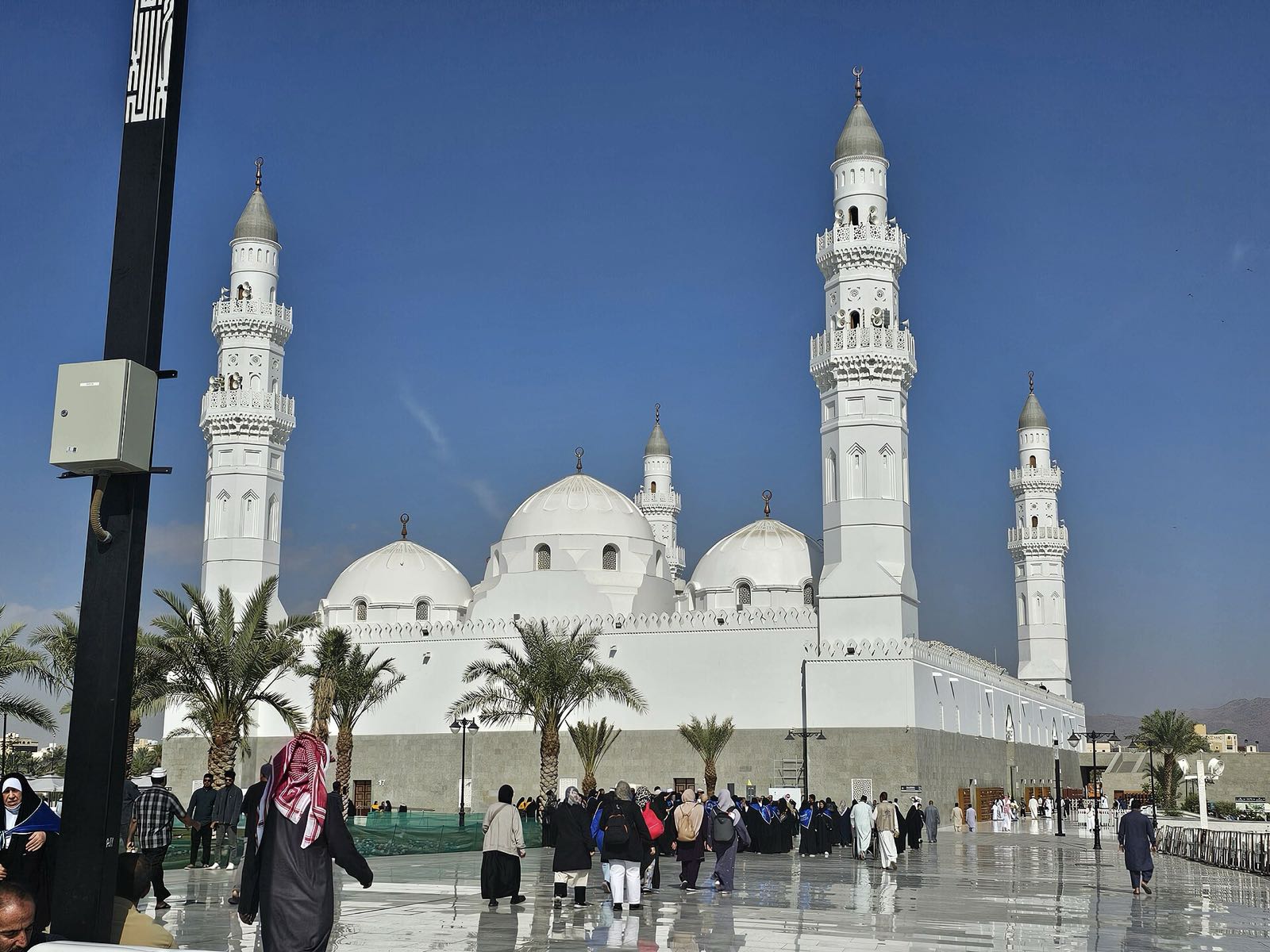
Masjid Quba
Masjid al-Qiblatayn
Mount Uhud and the Martyrs' Cemetery
Archers' Hill
The Seven Mosques – site of the Battle of the Trench
The Friday Mosque
Masjid al-Anbariyah
The date palm gardens

Makkah al-Mukarramah
Masjid al-Haram
The Holy Kaaba
The birthplace of the Prophet (peace be upon him)
Jannat al-Mu'alla Cemetery
Mount Nur (Jabal an-Nur) – Cave of Hira
Mount Thawr (Jabal Thawr)
Masjid ash-Shajarah
Arafat
Muzdalifah
Masjid al-Jinn
Mina
Hudaybiyah
Ji'ranah
Masjid al-Aqabah
Accommodation
Hotel Information
Shisha district, shuttle service, 3–4 km
Makkah
Breakfast + dinner
Markaziyah district, Madinah
Madinah
Breakfast + dinner
What's Covered
What's Included / Not Included
Included in the Price
Return air ticket
Accommodation for the full duration in the hotels stated
Breakfast and dinner
Visa and consular formalities
Travel insurance
Diyanet card
Coach transfers in Jeddah, Makkah and Madinah
Airport welcome and send-off
Sightseeing around Makkah and Madinah
Visit to the date palm gardens
1 travel bag and 1 backpack – with luggage tag
Umrah guidebook – the Umrah pilgrim's handbook
5 litres of Zamzam water, provided at the airport on return
Saygın Turizm guiding service
Not Included in the Price
Turkish departure tax (TRY 1,250)
Passport application costs
Personal expenses
Ihram garments and open-toe, open-heel sandals for male pilgrims
Good to Know
Important Information and Terms
1
One third of the payment is due at registration, and the remaining balance must be paid no later than 10 days before departure.
2
For cancellations made after the visa application has been submitted, a charge of USD 300 applies; for cancellations made after the air ticket has been issued, the penalty imposed by the airline concerned applies in addition.
3
If a pilgrim cancels their Umrah registration for any reason, the costs we have already incurred will be charged to them.
4
If a pilgrim wishes to end their Umrah journey early, they are responsible for the return ticket change fee and the airport transfer.
5
If, after departure, a pilgrim wishes to return later than scheduled, this is subject to the availability and the rules of the airline used. Any resulting difference in fare is payable by the pilgrim.
6
Saygın Turizm reserves the right to pass on to the tour price any additional charges arising, during the Umrah visa process under the Umrah Program, from changes in taxes, duties, fees and similar statutory levies collected by airports or comparable institutions and authorities.
7
We wish all our pilgrims a blessed journey.
Common Questions
Frequently Asked Questions
Passport (valid for at least 7 months from the flight date) · meningitis vaccination card · deposit payable on confirmed registration · the passport must be delivered to us at least 15 days before the flight.
One third of the payment is due at registration, and the remaining balance must be paid no later than 10 days before departure. For cancellations made after the visa application has been submitted, a charge of USD 300 applies; for cancellations made after the air ticket has been issued, the penalty imposed by the airline concerned applies in addition. If a pilgrim cancels their Umrah registration for any reason, the costs we have already incurred will be charged to them. If a pilgrim wishes to end their Umrah journey early, they are responsible for the return ticket change fee and the airport transfer. If, after departure, a pilgrim wishes to return later than scheduled, this is subject to the availability and the rules of the airline used, and any resulting difference in fare is payable by the pilgrim. Saygın Turizm reserves the right to pass on to the tour price any additional charges arising, during the Umrah visa process under the Umrah Program, from changes in taxes, duties, fees and similar statutory levies collected by airports or comparable institutions and authorities. We wish all our pilgrims a blessed journey.
Once a person has completed an Umrah, in order to perform another one they must go back outside the boundaries of the Haram and enter Ihram there. The best known place for this is Tan'im, where the Mosque of Aisha (may Allah be pleased with her) stands (Kāsānī, Badā'i‘, II, 167).
Those who live in the towns and countries lying outside the miqat are called "afaqi". For afaqi pilgrims travelling to the Hijaz to perform Hajj or Umrah, the places at which they are to enter Ihram were designated by the Prophet (peace be upon him) himself, according to the region or country they come from. These places, known as the miqat, are five in number. It is related that Ibn Abbas (may Allah be pleased with him) said: "The Prophet (peace be upon him) appointed Dhul-Hulayfah as the miqat for the people of Madinah, al-Juhfah for the people of Syria, Qarn al-Manazil for the people of Najd and Yalamlam for the people of Yemen. These are also the miqat for travellers from other lands who come by way of those regions or countries." (Bukhārī, Hajj, 7–13, Jazā' as-Sayd, 18; Muslim, Hajj, 11–18; Abū Dāwūd, Manāsik, 9; Nasā'ī, Manāsik, 17–23). In another hadith, Dhat Irq is added for the people of Iraq (Abū Dāwūd, Manāsik, 8). If a pilgrim's route does not pass through these points, they enter Ihram at the point level with them. According to the majority of scholars, Jeddah is counted as part of the Hill, that is, inside the miqat (Ibn ‘Ābidīn, Radd al-muhtār, III, 482, 625). Accordingly, afaqi pilgrims may not enter Ihram at Jeddah. Whether they arrive by sea or by air, those coming from the north and the west should enter Ihram before passing the point level with al-Juhfah.
Although it is fitting and preferable to recite the supplications found in the Qur'an or related from the Prophet (peace be upon him) and his Companions, it is not obligatory to recite them word for word. Those who wish may make use of these supplications, but they may equally recite supplications they already know and regularly use. Those who cannot pronounce the supplications given in the books because they cannot read Arabic, or who find the pronunciation difficult, may recite a translation of the supplication they wish to make. Indeed, the finest way for a person to open their heart to the Almighty is to pray as their heart moves them.
Someone who has entered Ihram for Umrah but does not feel well enough to perform it waits in Ihram until they recover; once they are well, they perform their tawaf and sa'y, have their hair cut and leave Ihram. No penalty is due for postponing the tawaf and sa'y. However, they must observe the prohibitions of Ihram throughout the period of waiting.
Makkah — and above all Masjid al-Haram, al-Mash'ar al-Haram and Arafat — holds a particular sanctity in the hearts of Muslims as the place where the pillars and conditions of the Hajj are fulfilled. That sanctity belongs to the places themselves, not to their stones, soil, plants or animals. There is therefore no basis for bringing back soil or stones from the Hijaz in the hope of blessing (Sarakhsī, al-Mabsūt, XXX, 161). The great majority of scholars have not considered this correct, and some have even said that it is forbidden or disliked (Nawawī, al-Majmū‘, VII, 454–455).
During a stay in Madinah al-Munawwarah for Hajj or Umrah, care is taken to perform the five daily prayers in Masjid an-Nabawi. The Prophet (peace be upon him) stated that a single prayer performed in Masjid an-Nabawi is better than a thousand prayers performed in any other mosque, save Masjid al-Haram (Bukhārī, Fadl as-salāt, 1). A belief has become widespread among people that one must stay eight days in Madinah and perform forty prayers there. The basis of this belief is the following hadith related from the Prophet (peace be upon him), although its authenticity is disputed: "Whoever performs forty prayers in this mosque of mine without missing a single one will be granted release from the Fire and deliverance from punishment, and will be free of hypocrisy." (Ahmad b. Hanbal, al-Musnad, XX, 40; Tabarānī, al-Mu‘jam al-awsat, II, 22). Scholars of hadith have stated that the authenticity of this report is disputed both in its chain of transmission and in its text (see Albānī, ad-Da‘īfa, I, 540; Rufā‘ī, al-Ahādīth, pp. 435–436). Nor do the works of fiqh contain any emphatic ruling that pilgrims must not neglect forty prayers in Masjid an-Nabawi. In this connection, the following hadith is known to be sounder in its text: "Whoever prays in congregation for forty days, catching the opening takbir, will be granted release from two things: from the Fire of Hell and from hypocrisy." (Tirmidhī, Salāt, 66). Accordingly, those whose stay in Madinah is long enough would do well to continue praying in congregation in the mosque of the Prophet (peace be upon him), beside his Rawdah, without counting the number of prayers. If, however, the organisation of the journey makes a shorter stay necessary, this should be accepted with understanding, and it should not be thought a deficiency to have been unable to perform forty prayers. For performing forty prayers in Masjid an-Nabawi is neither an obligation (fard), nor a requirement (wajib), nor a sunnah of the Hajj. The completion of the Hajj should therefore not be made contingent on these prayers.
It is a sunnah for someone entering Ihram to perform two rak'ahs of prayer. If it is one of the times at which prayer is disliked, this prayer should not be performed. If it is forgotten at the miqat, it may be performed after arriving in Makkah; no material penalty is due. Performing the obligatory prayer of the current time also takes the place of these two rak'ahs. It is meritorious to recite Surah al-Kafirun after al-Fatihah in the first rak'ah, and Surah al-Ikhlas in the second (al-Fatāwā al-Hindiyya, I, 246).
According to the Hanafi school, anyone wishing to enter the area of the Haram — for whatever purpose — must pass the miqat in a state of Ihram; according to the Shafi'i school, this applies to those entering in order to perform Hajj or Umrah. If someone travelling for Hajj or Umrah passes the miqat boundary without entering Ihram, for whatever reason, and then returns before beginning any of the rites and enters Ihram at one of the miqat points designated for afaqi pilgrims before re-entering, no penalty is due. If they do not go back, then according to the Hanafis they enter Ihram where they are and sacrifice a sheep or a goat (Kāsānī, Badā'i‘, II, 164–165; Nawawī, al-Majmū‘, VII, 10–14). This is known as the penalty hady. Such sacrifices may be offered during the days of Eid al-Adha or on other days, provided they are made within the boundaries of the Haram (Marghīnānī, al-Hidāya, II, 492–493; Nawawī, al-Majmū‘, VII, 499).
Such a person must first remove their clothing, wrap themselves in the Ihram garments and perform their tawaf and sa'y. However, because they wore clothing for a full day or night while in Ihram, a dam is due as a penalty, that is, the sacrifice of a sheep or a goat (Ibn ‘Ābidīn, Radd al-muhtār, III, 488, 577). According to the Shafi'i school, the passing of a full day or night is not required for the penalty to apply, and they may choose, as a penalty, between a dam (sacrificing a sheep or a goat), fasting for three days, or giving charity to the amount of six fitrahs (Nawawī, al-Majmū‘, VII, 383; Ramlī, Nihāyat al-muhtāj, III, 358; Dimyātī, Hāshiyat i‘ānat at-tālibīn, II, 540–541; Ibn Qudāma, al-Mughnī, V, 381–382).
If a person in Ihram wears sewn clothing or underwear for a full day or a full night, they must offer a dam, that is, sacrifice a sheep or a goat. If the garment is worn for less than a day or a night, they give the amount of sadaqat al-fitr in charity (Ibn ‘Ābidīn, Radd al-muhtār, III, 488, 577). According to the Shafi'i, Hanbali and Maliki schools, a person who wears such clothing may choose, regardless of the length of time, between a dam, fasting for three days, or giving charity to six poor people; the passing of a full day or night is not required for the penalty to apply (Nawawī, al-Majmū‘, VII, 383; Ibn Qudāma, al-Mughnī, V, 381–382).
Someone who wears clothing because of illness should, as soon as they recover, wrap themselves in the Ihram garments again and perform their tawaf and sa'y. Such a person may choose between sacrificing a sheep or goat, fasting for three days, or giving charity to six poor people (Mawsilī, al-Ikhtiyār, I, 506; Shirbīnī, Mughnī al-muhtāj, I, 754; Ibn Qudāma, al-Mughnī, V, 151–152, 385).
To leave Ihram, the hair must be cut. Someone who, having reached the point of leaving Ihram, puts on clothing without first having their hair cut has violated a prohibition of Ihram. If the clothing was worn for a full day or night, a dam is due, that is, the sacrifice of a sheep or a goat; if it was worn for less than a day or a night, charity to the amount of one fitrah must be given (Ibn ‘Ābidīn, Radd al-muhtār, III, 488, 577). According to the Shafi'i school, such a person may exercise a choice and offer, as a penalty, a dam, fast for three days, or give charity to the amount of six fitrahs (Nawawī, al-Majmū‘, VII, 367–368, 383; Ibn Qudāma, al-Mughnī, V, 381–382).
According to the Hanafi school, someone who while in Ihram shaves at least a quarter of their hair or beard, or removes the hair from at least one armpit or all of the hair from the groin, owes a dam as a penalty, that is, the sacrifice of a sheep or a goat (Mawsilī, al-Ikhtiyār, I, 502). According to the Shafi'i school, such a person may exercise a choice between a dam, fasting for three days, or giving charity to six poor people (Nawawī, al-Majmū‘, VII, 247, 367–368, 371, 376; Ibn Qudāma, al-Mughnī, V, 381–382).
According to the Hanafi school, someone who shaves at least a quarter of their beard while in Ihram owes a dam as a penalty, that is, the sacrifice of a sheep or a goat (Ibn ‘Ābidīn, Radd al-muhtār, III, 579). According to the Shafi'i, Hanbali and Maliki schools, such a person may choose between a dam, fasting for three days, or giving charity to six poor people (Nawawī, al-Majmū‘, VII, 247, 367–368, 372; Ibn Qudāma, al-Mughnī, V, 381–382).
It is forbidden for a person in Ihram to cut their nails. If they do so, a penalty is due, and its extent depends on how much was cut. Thus, if all the nails, or all the nails of one hand or one foot, are cut on a single occasion (at the same time and in the same place), a dam is due, that is, the sacrifice of a sheep or a goat. If only some of the nails of a hand or foot are cut rather than all of them, charity is given for each nail cut. If all the nails of each hand and foot are cut at different times and places, a separate penalty is due for each. If the total charity due exceeds the value of a sheep or a goat, then instead of charity for each nail, a single dam may be offered for all of them if preferred. Pulling off or trimming nails that have already come loose or broken of their own accord does not entail a penalty (Sarakhsī, al-Mabsūt, IV, 77; Mawsilī, al-Ikhtiyār, I, 502).
According to the Hanafi school, someone who has made the intention for Umrah, entered Ihram, performed the tawaf of Umrah and then had their hair cut without performing sa'y has left Ihram. In that case they perform the sa'y of Umrah, but since it is obligatory (wajib) to perform the sa'y of Umrah while in Ihram, a dam is due, that is, the sacrifice of a sheep or a goat (Mawsilī, al-Ikhtiyār, I, 504). According to the Shafi'i, Maliki and Hanbali schools, since sa'y is one of the pillars of Umrah, a person who has their hair cut without performing sa'y does not leave Ihram; they have violated a prohibition of Ihram. What they must do is, if they have put on clothing, wrap themselves in the Ihram garments again, perform the sa'y of Umrah, and only then have their hair cut and leave Ihram. Furthermore, because they had their hair cut and wore clothing before the time for leaving Ihram (that is, before the sa'y), two penalties are due. As to the penalty, they may exercise a choice between two dams, fasting for six days, or giving charity to the amount of twelve fitrahs (Ibn Rushd, Bidāya, I, 366).
The sa'y of someone who performs sa'y and has their hair cut before performing tawaf is not valid, since for sa'y to be valid it must follow a valid tawaf (Kāsānī, Badā'i‘, II, 134). Such a person therefore does not leave Ihram; they have violated a prohibition of Ihram. They must first perform their tawaf, then repeat their sa'y, and only then leave Ihram. In addition, because they violated a prohibition of Ihram by having their hair cut before the time for leaving Ihram had come, a dam is due, that is, the sacrifice of a sheep or a goat (Mawsilī, al-Ikhtiyār, I, 502). According to the Shafi'i school, they may exercise a choice and offer, as a penalty, a dam, fast for three days, or give charity to the amount of six fitrahs (Nawawī, al-Majmū‘, VII, 247, 367–368).
Someone who has their hair cut without performing tawaf and sa'y does not thereby leave Ihram; they have violated a prohibition of Ihram. Such a person pays whatever penalty is due for the prohibition they have violated — cutting the nails, wearing clothing, cutting the hair, applying perfume, sexual relations and the like (Mawsilī, al-Ikhtiyār, I, 502). Moreover, if they have put on clothing, they must remove it, wrap themselves in the Ihram garments and perform their tawaf and sa'y.
Someone who has entered Ihram for Umrah, performed the tawaf and sa'y, and then forgotten to have their hair cut must do so as soon as they remember. If they have violated any prohibitions of Ihram in the meantime, they pay the penalty due according to the nature of the prohibition violated.
